
Ask most people when a nonprofit’s work begins, and they’ll say it begins when the money goes out. A check gets written, a project gets funded, and that’s the moment things start happening.
We see it differently.
At Small Magic Foundation, the work starts the first time a teenager walks into one of our workshops. No application has been submitted. No decision has been made. There’s no grant yet, and there might never be one for that particular idea. And still, something is already shifting in the room.
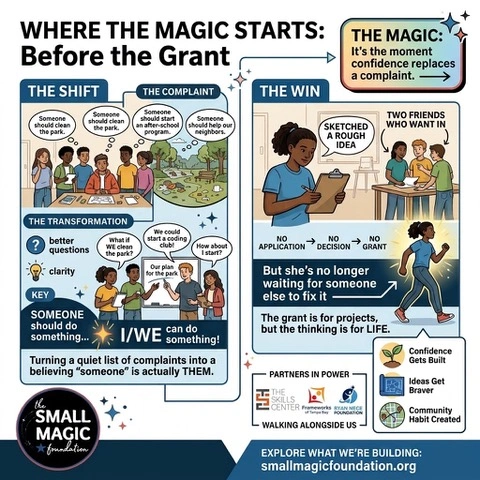
Here’s what we mean. A lot of young people carry around a quiet list of things that bug them. The park that never gets cleaned up. The kids who don’t have anywhere to go after school. The neighbor who could use a hand. Most of the time, that list stays in their heads, filed under “someone should really do something about that.” The word that matters there is someone. It almost never means them.
Our workshops are built to change that one word. We’re not handing teens answers. We’re asking better questions. What do you notice? What would you change? What would it take to start? Somewhere in the middle of that conversation, the complaint turns into a possibility, and the possibility starts to sound a lot like a plan.
Imagine a sixteen-year-old who comes to a workshop with nothing more than a feeling that her neighborhood could be better. She isn’t sure what she wants to do, or whether anyone would care. By the end of the session she’s sketched out a rough idea, found two friends who want in, and learned what a first step could look like. She hasn’t asked us for a dollar yet. But she’s no longer waiting for someone else to fix it.
That shift is the real beginning. The grant helps a plan become a project, but the thinking has to come first. A teen who sees opportunity where she used to see a problem will carry that habit long after any one project ends.
We don’t know about you, but we think that’s a pretty good return on a Saturday afternoon.
It also changes how we think about our job. We could treat the workshop as a hoop to jump through on the way to funding. Instead, we treat it as part of the program itself, a place where confidence gets built and ideas get a little braver. Every teen who leaves with a clearer sense of what’s possible is a win, whether or not their name ever lands on a grant.
This is also where our community partners come in. In the coming weeks, we’ll be introducing you to The Skills Center, Frameworks of Tampa Bay, and the Ryan Nece Foundation, the organizations walking alongside us in this work. You’ll see why having the right neighbors matters when you’re trying to help young people believe in what they can do.
For now, we’d love for you to hold onto one idea. The magic doesn’t wait for the grant. It starts the moment a teenager decides that “someone should do something” might actually mean her.